Arithmetic Operation Utility

Fraction Calculator

Perform arithmetic operations (addition, subtraction, multiplication, and division) on proper, improper, and mixed fractions with automated common denominators.

View full step-by-step arithmetic explanations, unsimplified intermediate ratios, and exact decimal equivalents for every operation.
All 4 Basic Operations Automated Common Denominator Simplified Answers
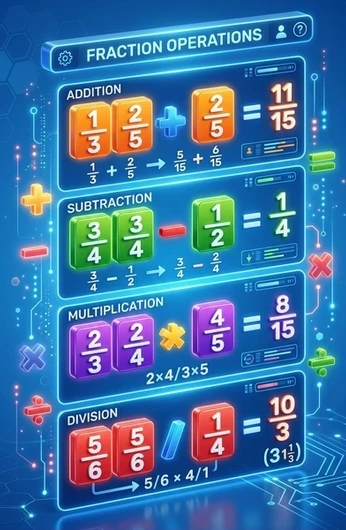
Fraction Operations Graphic
Simplified Result
3/4
Unsimplified Result
6/8
Decimal Value
0.75
Mixed Number
Not Applicable

Step-by-Step Calculation

    How Fraction Operations Work

    Master the step-by-step mathematical procedures for adding, subtracting, multiplying, and dividing fractions.

    1
    Identify the Operation Type
    Determine whether the problem involves finding a common denominator (addition/subtraction), multiplying numerators and denominators (multiplication), or taking a reciprocal (division).
    2
    Apply Fraction Arithmetic Formula
    Execute the calculation to get the intermediate unsimplified numerator and denominator (e.g. cross-multiplying (a·d ± b·c) / (b·d)).
    3
    Simplify to Lowest Terms (GCD Reduction)
    Find the Greatest Common Divisor (GCD) of the resulting numerator and denominator and divide both by the GCD to yield the simplest fraction form.
    Worked Step-by-Step Example: Add 1/2 + 1/4
    1. Cross-multiply numerators: (1 × 4) + (2 × 1) = 4 + 2 = 6.
    2. Multiply denominators for common base: 2 × 4 = 8.
    3. Unsimplified Result: 6/8.
    4. Compute GCD(6, 8) = 2 → Divide top and bottom by 2: 3/4.

    The 4 Basic Fraction Operations

    Comprehensive breakdown of formulas, cross-multiplication, and reduction methods for all standard operations.

    Addition (+)
    (a/b) + (c/d) = (a·d + b·c) / (b·d)
    Cross-multiply each numerator by the opposite denominator, add the products together over common denominator b·d, then reduce using GCD. Example: 1/2 + 1/3 = (3+2)/6 = 5/6.
    Subtraction (−)
    (a/b) − (c/d) = (a·d − b·c) / (b·d)
    Cross-multiply numerators, subtract the second product from the first over common denominator b·d, and simplify to lowest terms. Example: 3/4 − 1/3 = (9−4)/12 = 5/12.
    Multiplication (×)
    (a/b) × (c/d) = (a·c) / (b·d)
    Multiply top numbers together and bottom numbers together directly. No common denominator is needed. Example: (2/3) × (3/4) = 6/12 = 1/2.
    Division (÷)
    (a/b) ÷ (c/d) = (a/b) × (d/c) = (a·d) / (b·c)
    Multiply the first fraction by the reciprocal (flipped version) of the second fraction. Example: (2/3) ÷ (4/5) = (2·5)/(3·4) = 10/12 = 5/6.

    Fractions With Different Denominators

    How to perform addition, subtraction, and comparisons when fractions have unequal base denominators.

    Step 1: Universal Base
    Find a Common Base (Product or LCM)
    When adding or subtracting a/b and c/d with b ≠ d, scale both fractions to a shared denominator base: Common Denominator = b × d or Lowest Common Denominator (LCD).
    Step 2: Cross-Multiply
    Adjust Numerators Proportionally
    Multiply numerator a by denominator d, and numerator c by denominator b: (a · d ± b · c) / (b · d).
    Step 3: Simplify
    Reduce to Simplest Lowest Terms
    Divide the resulting combined numerator and common denominator by their Greatest Common Divisor (GCD).
    Worked Example: Add 2/5 + 1/3 (Different Denominators)
    1. Multiply denominators: 5 × 3 = 15.
    2. Cross-multiply numerators: (2 × 3) + (1 × 5) = 6 + 5 = 11.
    3. Result: 11/15 (GCD is 1, fraction is irreducible).

    Fractions With the Same Denominator

    Direct addition and subtraction rules when fractional parts already share equal sizes.

    Like Denominators
    Keep the Base & Combine Numerators
    When fractions share the same denominator c, add or subtract numerators directly while leaving the bottom number unchanged: (a/c) ± (b/c) = (a ± b) / c.
    Direct Addition
    (a/c) + (b/c) = (a + b) / c
    Simply sum top values. Example: 3/8 + 1/8 = (3+1)/8 = 4/8.
    Direct Subtraction
    (a/c) − (b/c) = (a − b) / c
    Subtract second numerator from the first. Example: 7/10 − 3/10 = 4/10.
    Worked Example: 3/8 + 1/8
    1. Same denominator (8): Add top numbers 3 + 1 = 4.
    2. Intermediate ratio: 4/8.
    3. Simplify with GCD(4, 8) = 4: (4 ÷ 4) / (8 ÷ 4) = 1/2.

    Mixed Number Calculations

    How to calculate arithmetic operations involving whole numbers combined with proper fractions.

    1
    Convert Mixed Numbers to Improper Fractions
    Multiply whole number W by denominator b and add numerator a: Improper = (W · b + a) / b. Example: 1 1/2 = (1·2 + 1)/2 = 3/2.
    2
    Perform Operation on Improper Fractions
    Apply standard fraction arithmetic (+, −, ×, ÷) to the converted improper fractions.
    3
    Simplify & Convert Back to Mixed Form
    Simplify using GCD reduction. If the resulting numerator exceeds the denominator, convert back into mixed number format: Whole = Numerator ÷ Denominator, Remainder / Denominator.
    Worked Example: Add 1 1/2 + 2 1/4
    1. Convert to improper: 1 1/2 = 3/2 and 2 1/4 = 9/4.
    2. Add fractions: 3/2 + 9/4 = 6/4 + 9/4 = 15/4.
    3. Convert 15/4 back to mixed number: 15 ÷ 4 = 3 remainder 33 3/4.

    Improper Fraction Calculations

    Managing operations where top numerators are greater than or equal to bottom denominators.

    Definition
    Numerator ≥ Denominator
    An improper fraction represents a value equal to or greater than 1 (e.g. 7/4, 15/8, 9/3). All arithmetic operations execute seamlessly on improper fractions.
    Calculation Advantage
    Seamless Algebra Execution
    Unlike mixed numbers, improper fractions do not require splitting whole integers during multiplication or division. Top numbers multiply top numbers directly.
    Sign Conventions
    Negative Improper Fractions
    Negative signs are attached to the top numerator: -9/4 or written in front -(9/4). Converted mixed forms retain the leading negative sign: -2 1/4.
    Worked Example: Multiply 9/4 × 2/3
    1. Multiply top and bottom: (9 × 2) / (4 × 3) = 18/12.
    2. Compute GCD(18, 12) = 6 → Simplify: (18 ÷ 6) / (12 ÷ 6) = 3/2.
    3. Express as Improper: 3/2  |  Express as Mixed Number: 1 1/2.

    Simplifying Fraction Results

    Reducing raw calculation answers to irreducible lowest terms using Euclidean GCD algorithms.

    Euclidean Algorithm
    Find Greatest Common Divisor (GCD)
    Compute the largest positive integer that divides both numerator and denominator without remainder: g = GCD(|Numerator|, |Denominator|).
    Division Step
    Divide Top and Bottom by GCD
    Scale down raw result ratio: New Numerator = Numerator ÷ g and New Denominator = Denominator ÷ g.
    Coprime Terms
    Irreducible Form (GCD = 1)
    When GCD is 1, the numerator and denominator share no common factors other than 1. The fraction is already in simplest form.
    Worked Example: Simplify 24/36
    1. Factors of 24: 1, 2, 3, 4, 6, 8, 12, 24.
    2. Factors of 36: 1, 2, 3, 4, 6, 9, 12, 18, 36.
    3. Greatest Common Divisor (GCD) = 12.
    4. Simplify: (24 ÷ 12) / (36 ÷ 12) = 2/3.

    Common Denominators & LCD Methods

    Understanding why equal-sized fractional parts are required for addition and subtraction.

    Cross-Multiplication Method
    Universal Denominator Product
    Multiplying denominators b × d creates a guaranteed common base for any two fractions without needing factor searches.
    Least Common Denominator (LCD)
    Least Common Multiple (LCM)
    Finding LCM(b, d) produces the smallest common denominator, keeping intermediate numbers smaller and reducing simplification steps.
    Equivalent Scaling
    Proportional Numerator Scaling
    Both fractions are scaled up by multiplying numerators and denominators by matching scale factors so their parts represent identical sizes.
    LCD Comparison: 1/4 + 1/6
    1. Universal Product method: (1·6 + 4·1) / 24 = 10/24 = 5/12.
    2. Least Common Denominator (LCD = 12) method: (3 + 2) / 12 = 5/12.
    Both methods give identical mathematical results. The LCD method works with smaller numbers.

    Fraction Rules & Formulas

    Essential reference of fundamental algebraic laws, identities, and zero rules governing fractions.

    Addition Rule
    (a/b) + (c/d) = (a·d + b·c) / (b·d)
    Requires scaling both fractions to a common denominator base before adding top numerators.
    Worked Example: 1/2 + 1/3 = (3 + 2) / 6 = 5/6
    Subtraction Rule
    (a/b) − (c/d) = (a·d − b·c) / (b·d)
    Requires scaling both fractions to a common denominator base before subtracting top numerators.
    Worked Example: 3/4 − 1/3 = (9 − 4) / 12 = 5/12
    Multiplication Rule
    (a/b) × (c/d) = (a·c) / (b·d)
    Direct multiplication of top numerators together and bottom denominators together. No common base required.
    Worked Example: (2/3) × (3/4) = 6/12 = 1/2
    Division Rule
    (a/b) ÷ (c/d) = (a·d) / (b·c)
    Multiply the first fraction by the reciprocal (flipped inverted ratio) of the second fraction.
    Worked Example: (2/3) ÷ (4/5) = (2·5) / (3·4) = 10/12 = 5/6
    Identity Element Law
    a / a = 1  |  a / 1 = a
    Any non-zero integer over itself equals 1; any integer over 1 equals itself.
    Worked Example: 5/5 = 1  |  7/1 = 7
    Zero Numerator Law
    0 / b = 0  (for b ≠ 0)
    Zero divided by any non-zero integer denominator always yields a result of zero.
    Worked Example: 0 / 8 = 0
    Undefined Division Law
    a / 0 = Undefined
    Division by zero is mathematically impossible and results in an undefined division error.
    Worked Example: 5 / 0 → Undefined (Division Error)
    Sign Shift Rule
    -a / b = a / -b = -(a / b)
    Positioning negative signs on the numerator, denominator, or in front of the fraction represent identical numerical values.
    Worked Example: -3/4 = 3/-4 = -(3/4)
    Double Negative Rule
    -a / -b = a / b
    Dividing a negative numerator by a negative denominator cancels out negative signs to yield a positive fraction.
    Worked Example: -6 / -8 = 6/8 = 3/4
    Reciprocal Identity
    (a / b) × (b / a) = 1
    Multiplying any non-zero fraction by its inverted reciprocal always equals 1.
    Worked Example: (3/4) × (4/3) = 12/12 = 1

    Fraction Operations Reference Chart

    Comprehensive reference showing unsimplified products, GCD reduction factors, and final simplified outputs.

    Operation Expression Unsimplified Ratio GCD Factor Simplified Result Decimal Value
    Addition1/2 + 1/46/823/40.75
    Addition2/3 + 3/519/15119/15 (1 4/15)1.2667
    Subtraction3/4 − 1/35/1215/120.4167
    Subtraction5/6 − 1/24/1241/30.3333
    Multiplication2/3 × 3/46/1261/20.5
    Multiplication4/5 × 5/820/40201/20.5
    Division2/3 ÷ 4/510/1225/60.8333
    Division3/4 ÷ 1/26/423/2 (1 1/2)1.5

    Frequently Asked Questions

    Answers to common questions regarding fraction arithmetic, common denominators, and reciprocals.

    The denominator represents the size of each fractional slice. You can only combine or subtract quantities when they are divided into equal-sized units. Finding a common denominator scales both fractions to matching slice sizes.
    Multiplication finds a fraction of another fraction (scaling parts of parts), so numerators and denominators multiply directly. Division computes how many times one fraction fits into another by using reciprocal multiplication.
    The reciprocal of a fraction is formed by swapping its numerator and denominator (e.g., the reciprocal of 4/5 is 5/4). Dividing by a fraction is mathematically identical to multiplying by its reciprocal.
    Negative signs adhere to standard rules of signs: negative times negative yields positive, negative times positive yields negative. Negative signs in denominators are automatically normalized to the numerator in final simplified outputs.
    If the resulting simplified numerator is greater than the denominator (e.g. 7/4), divide 7 by 4: whole quotient = 1, remainder = 3. The mixed number is 1 3/4.