Mixed Number Calculator
Add, subtract, multiply, and divide mixed numbers, or convert between mixed numbers, improper fractions, and decimals with transparent step-by-step math steps.
Simplify fractional components, evaluate whole integer remainders, and copy exact results for homework or technical calculations.
Step-by-Step Calculation
Step-by-Step Calculation
Step-by-Step Calculation
Step-by-Step Calculation
Understanding Mixed Numbers and Improper Fractions
Core mathematical concepts, definitions, and representations for values greater than 1.
2 ¾ cups or 1 ½ hours. Learn more about mixed numbers.
Mixed Number Rules & Formulas
Fundamental mathematical formulas and conversion rules for mixed fraction calculations.
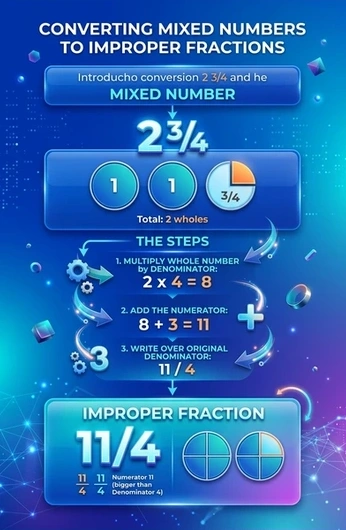
Multiply the whole integer W by denominator D, add numerator N, and place over denominator D.
Divide numerator by denominator. Integer quotient = whole number, remainder = new numerator.
How to Convert a Mixed Number to an Improper Fraction
Follow these 3 algebraic steps to convert any mixed quantity into a single improper fraction.
3 × 5 = 15.2. Add existing numerator:
15 + 2 = 17 (new improper numerator).3. Keep original denominator: 5.
4. Final Improper Fraction: 17/5. Decimal value =
3.4.
How to Convert an Improper Fraction to a Mixed Number
Use integer division and remainder calculation to extract whole units and proper fractional parts.
17 ÷ 5 = 3 quotient with remainder.2. Calculate remainder:
17 - (3 × 5) = 17 - 15 = 2.3. Whole part = 3, Remainder numerator = 2, Denominator = 5.
4. Final Mixed Number: 3 2/5.
How to Add Mixed Numbers
Step-by-step methods for adding mixed fractions using common denominators or improper conversions.
2 1/3 = 7/3 and 1 3/4 = 7/4.2. Common denominator base (12):
7/3 = 28/12 and 7/4 = 21/12.3. Add numerators:
(28 + 21) / 12 = 49/12.4. Convert to mixed number:
49 ÷ 12 = 4 remainder 1 → 4 1/12.
How to Subtract Mixed Numbers
Perform subtraction cleanly with common denominators, borrowing (regrouping), or improper fraction conversion.
1/4 - 3/4 requires borrowing.2. Regroup 4 1/4:
4 1/4 = 3 + (1 + 1/4) = 3 5/4.3. Subtract:
(3 - 1) + (5/4 - 3/4) = 2 2/4.4. Reduce 2/4 using GCD (2): 2 1/2.
How to Multiply Mixed Numbers
Convert mixed numbers to improper fractions, then multiply top numbers and bottom numbers directly.
1 1/2 = 3/2 and 2 2/3 = 8/3.2. Multiply numerators and denominators:
(3 × 8) / (2 × 3) = 24 / 6.3. Divide:
24 ÷ 6 = 4 (exact integer with zero remainder).4. Final Product: 4.
How to Divide Mixed Numbers
Convert to improper fractions, flip the second fraction to its reciprocal, and multiply.
3 1/2 = 7/2 and 1 3/4 = 7/4.2. Reciprocal & Multiply:
(7/2) × (4/7) = (7 × 4) / (2 × 7) = 28 / 14.3. Simplify:
28 ÷ 14 = 2.4. Final Quotient: 2.
Simplifying Mixed Number Results
Reduce fractional remainders to lowest terms and carry over improper fractional parts.
GCD(6, 8) = 2.2. Divide numerator:
6 ÷ 2 = 3.3. Divide denominator:
8 ÷ 2 = 4.4. Simplified Result: 2 3/4.
Mixed Number Examples
Reference table of common mixed numbers, improper fraction equivalents, and decimal values.
Decimal Value:
1.5
Decimal Value:
1.75
Decimal Value:
2.25
Decimal Value:
2.375
Decimal Value:
3.3333... (Repeating)
Decimal Value:
4.4
Frequently Asked Questions
Common questions and answers regarding mixed fraction conversions and calculations.