Decimal to Fraction Calculator
Convert any terminating or repeating decimal into an exact, simplified fraction with instant step-by-step mathematical solutions.
Switch seamlessly between decimal-to-fraction and fraction-to-decimal modes to solve math problems, verify engineering specs, or reduce ratios.
Step-by-Step Calculation
Step-by-Step Calculation
How to Convert a Decimal to a Fraction
Follow these three essential mathematical steps to convert any terminating decimal into a reduced fraction.
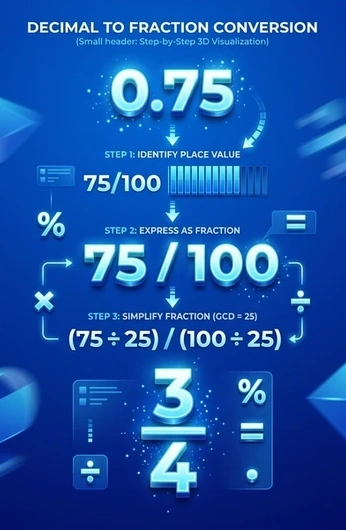
0.75 has two decimal places).75 / 100).3/4).1.25 → 2 decimal places.2. Place over 100:
125 / 100.3. Divide top & bottom by GCD (25):
(125 ÷ 25) / (100 ÷ 25) = 5/4 (or mixed number 1 1/4).
How to Simplify a Fraction
Reduce any fraction to its lowest terms (irreducible form) using the Greatest Common Divisor (GCD).
24/36, GCD is 12).(24 ÷ 12) / (36 ÷ 12) = 2/3.2/3 is fully simplified!2. Factors of 100: 1, 2, 4, 5, 10, 20, 25, 50, 100.
3. Greatest Common Divisor (GCD) = 25.
4. Simplify:
(75 ÷ 25) / (100 ÷ 25) = 3/4.
How to Convert a Fraction to a Decimal
Perform division by dividing the top number (numerator) by the bottom number (denominator).
Examples: 3/4 = 0.75, 1/8 = 0.125, 1/2 = 0.5.
Examples: 1/3 = 0.333..., 1/6 = 0.1666..., 2/3 = 0.666....
Example: For fraction 3/8, calculate
3 ÷ 8 = 0.375 (Terminating Decimal).
Terminating vs. Repeating Decimals
Understand the structural differences between finite terminating decimals and recurring repeating decimals.
Key Examples:
• 1/2 = 0.5 (1 decimal place)
• 3/4 = 0.75 (2 decimal places)
• 1/8 = 0.125 (3 decimal places)
Key Examples:
• 1/3 = 0.333...
• 1/6 = 0.1666...
• 1/7 = 0.142857...
Mixed Numbers and Improper Fractions
How decimals greater than 1 convert into improper fractions and whole-plus-fraction mixed numbers.
7/4, 15/8). When converting a decimal like 1.75 to a fraction:
1.75 = 175 / 100 = 7/4
1 3/4, 1 7/8). To convert an improper fraction to a mixed number, divide numerator by denominator:
7 ÷ 4 = 1 remainder 3 → 1 3/4
2, Decimal Part = 0.375.2. Convert decimal part:
0.375 = 375 / 1000.3. Simplify fraction using GCD (125):
(375 ÷ 125) / (1000 ÷ 125) = 3/8.4. Combine whole part and simplified fraction: 2 3/8 (or improper fraction 19/8).
Common Decimal to Fraction Examples
Explore instant conversion results for the most frequently calculated terminating and repeating decimals:
0.25 = 25/100 = 1/40.5 = 5/10 = 1/20.75 = 75/100 = 3/40.125 = 125/1000 = 1/80.375 = 375/1000 = 3/80.625 = 625/1000 = 5/80.875 = 875/1000 = 7/80.333... = 3/9 = 1/30.666... = 6/9 = 2/31.25 = 125/100 = 5/4 (1 1/4)Decimal to Fraction Conversion Reference Table
Below is a quick reference table of common decimal-to-fraction equivalents frequently used in math, engineering, and science:
| Decimal | Unsimplified Fraction | Simplified Fraction | Decimal Type |
|---|---|---|---|
| 0.1 | 10/100 | 1/10 | Terminating |
| 0.2 | 2/10 | 1/5 | Terminating |
| 0.25 | 25/100 | 1/4 | Terminating |
| 0.333... | 333/999 | 1/3 | Repeating |
| 0.5 | 5/10 | 1/2 | Terminating |
| 0.6 | 6/10 | 3/5 | Terminating |
| 0.666... | 666/999 | 2/3 | Repeating |
| 0.75 | 75/100 | 3/4 | Terminating |
| 0.8 | 8/10 | 4/5 | Terminating |
| 0.875 | 875/1000 | 7/8 | Terminating |
| 1.25 | 125/100 | 5/4 (1 1/4) | Terminating |
| 1.5 | 15/10 | 3/2 (1 1/2) | Terminating |
| 1.75 | 175/100 | 7/4 (1 3/4) | Terminating |
Common Fraction to Decimal Examples
Reference key division results and decimal equivalents for essential fractions:
1 ÷ 2 = 0.51 ÷ 3 = 0.333...1 ÷ 4 = 0.251 ÷ 5 = 0.21 ÷ 6 = 0.1666...3 ÷ 4 = 0.752 ÷ 3 = 0.666...5 ÷ 8 = 0.6257 ÷ 8 = 0.8759 ÷ 10 = 0.9Fraction to Decimal Conversion Reference Table
Below is a quick reference table of common fraction-to-decimal values, division operations, and percentage equivalents:
| Fraction | Division Expression | Decimal Equivalent | Percentage | Decimal Type |
|---|---|---|---|---|
| 1/2 | 1 ÷ 2 | 0.5 | 50% | Terminating |
| 1/3 | 1 ÷ 3 | 0.333... | 33.33% | Repeating |
| 1/4 | 1 ÷ 4 | 0.25 | 25% | Terminating |
| 1/5 | 1 ÷ 5 | 0.2 | 20% | Terminating |
| 1/6 | 1 ÷ 6 | 0.1666... | 16.67% | Repeating |
| 1/8 | 1 ÷ 8 | 0.125 | 12.5% | Terminating |
| 2/3 | 2 ÷ 3 | 0.666... | 66.67% | Repeating |
| 3/4 | 3 ÷ 4 | 0.75 | 75% | Terminating |
| 4/5 | 4 ÷ 5 | 0.8 | 80% | Terminating |
| 5/6 | 5 ÷ 6 | 0.8333... | 83.33% | Repeating |
| 7/8 | 7 ÷ 8 | 0.875 | 87.5% | Terminating |
| 9/10 | 9 ÷ 10 | 0.9 | 90% | Terminating |