Mathematical Reduction Tool

Fraction Simplifier

Reduce any proper or improper fraction to its simplest form instantly using Euclidean Greatest Common Divisor (GCD) algorithms.

Automatically normalize negative signs, find prime factors, and evaluate improper fractions into clean, easy-to-read mixed numbers.
Euclidean GCD Factor Auto Sign Normalization Mixed Number Output
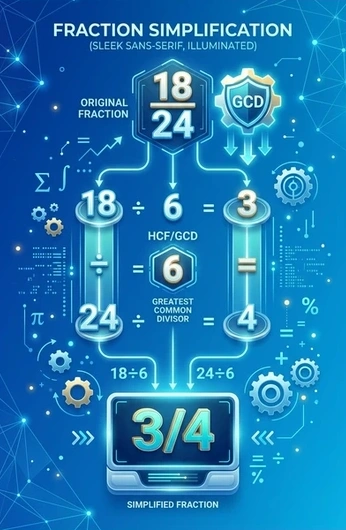
Fraction Simplification Graphic
Examples:
Simplest Form
3/4
Original Fraction
18/24
Greatest Common Divisor (GCD)
6
Mixed Number
Not Applicable

Step-by-Step Simplification

    How to Simplify a Fraction

    Reduce any proper or improper fraction to its lowest terms using Euclidean Greatest Common Divisor (GCD) algorithms.

    1
    Find Greatest Common Divisor (GCD)
    Identify the largest integer that divides evenly into both numerator and denominator (e.g., for 18/24, the GCD is 6).
    2
    Divide Top and Bottom by GCD
    Divide both numbers by the calculated GCD: (18 ÷ 6) / (24 ÷ 6) = 3/4.
    3
    Normalize Signs & Format Output
    Position negative signs on the numerator, cancel double negatives, and evaluate improper fractions into mixed numbers.
    Worked Step-by-Step Example: Reduce 18/24 to Lowest Terms
    1. Factors of 18 are: 1, 2, 3, 6, 9, 18.
    2. Factors of 24 are: 1, 2, 3, 4, 6, 8, 12, 24.
    3. The Greatest Common Divisor (GCD) is 6.
    4. Simplify: (18 ÷ 6) / (24 ÷ 6) = 3/4 (fully irreducible fraction).

    Greatest Common Divisor (GCD)

    Understanding the fundamental factor used to reduce any fraction to its irreducible lowest terms.

    Euclidean Algorithm
    Efficient Division Method
    The Euclidean algorithm repeatedly computes remainders: GCD(a, b) = GCD(b, a mod b) until the remainder reaches 0. It handles arbitrarily large integers instantly.
    Prime Factorization
    Shared Prime Factors
    Decompose both numbers into prime factors and multiply common primes. For 24 (2×2×2×3) and 36 (2×2×3×3), shared primes are 2×2×3 = 12.
    Coprime Numbers
    GCD = 1 (Irreducible)
    When two integers share no common factors other than 1 (such as 8 and 15), their GCD is 1. The fraction is already fully simplified.
    GCD Example: Find GCD(48, 180)
    1. 180 ÷ 48 = 3 remainder 36
    2. 48 ÷ 36 = 1 remainder 12
    3. 36 ÷ 12 = 3 remainder 0 → Greatest Common Divisor (GCD) = 12.

    Simplifying Fractions Using GCD

    Direct mathematical procedure for reducing fractions in a single step using the Greatest Common Divisor.

    Step 1
    Compute GCD of Numerator and Denominator
    Calculate g = GCD(|Numerator|, |Denominator|) using prime factors or Euclidean division.
    Step 2
    Divide Numerator by GCD
    Calculate new simplified numerator: New Numerator = Numerator ÷ g.
    Step 3
    Divide Denominator by GCD
    Calculate new simplified denominator: New Denominator = Denominator ÷ g.
    Single-Step Reduction Example: 45 / 60
    1. Compute GCD of 45 and 60: GCD(45, 60) = 15.
    2. Divide numerator: 45 ÷ 15 = 3.
    3. Divide denominator: 60 ÷ 15 = 4.
    4. Simplified Fraction: 3/4.

    Proper, Improper and Mixed Fractions

    Distinguishing between the three fundamental forms of mathematical fractions.

    Proper Fraction
    Numerator < Denominator
    A fraction where the top number is strictly smaller than the bottom number (e.g., 3/4, 7/10). Value is less than 1.
    Improper Fraction
    Numerator ≥ Denominator
    A fraction where the top number is greater than or equal to the bottom number (e.g., 15/4, 7/2). Value is 1 or greater.
    Mixed Fraction
    Whole Number + Proper Fraction
    Combines an integer whole number with a proper fraction (e.g., 3 3/4, 3 1/2). Converted directly from simplified improper fractions.
    Conversion Example: Improper Fraction 19/4 to Mixed Number
    1. Divide numerator by denominator: 19 ÷ 4 = 4 with a remainder of 3.
    2. Whole Number = 4, Remainder Numerator = 3, Denominator = 4.
    3. Mixed Number: 4 3/4.

    Equivalent Fractions

    Fractions that have different numerators and denominators but represent identical numerical values.

    Scaling Up
    Multiplication Rule
    Multiply numerator and denominator by any non-zero integer k:
    1/2 = (1×2)/(2×2) = 2/4 = (1×3)/(2×3) = 3/6 = 4/8.
    Simplifying Down
    Division Rule
    Divide numerator and denominator by a common factor:
    12/16 = (12÷4)/(16÷4) = 3/4. Simplification yields the unique irreducible equivalent fraction.
    Cross Multiplication
    Equivalence Test
    Two fractions a/b and c/d are equivalent if a × d = b × c. Example: 3/4 = 9/12 because 3 × 12 = 36 = 4 × 9.
    Chain of Equivalent Fractions
    1/2 = 2/4 = 3/6 = 4/8 = 5/10 = 50/100 = 0.5
    All these fractions represent the exact same decimal proportion (0.5). The fraction 1/2 is the simplest form of the family.

    Sign Normalization Rules for Negative Fractions

    Standard algebraic rules for handling negative signs in numerators and denominators.

    Negative Numerator
    -6 / 8 = -3/4
    Standard canonical mathematical representation. When only the top number is negative, the negative sign remains cleanly attached to the numerator: -6 / 8 = -3/4.
    Negative Denominator
    6 / -8 = -3/4
    Shift sign to numerator. Standard algebraic conventions require shifting negative signs from the bottom to the top for consistent equation formatting: 6 / -8 = -3/4.
    Double Negative
    -6 / -8 = 3/4
    Negatives cancel out. Dividing a negative number by another negative number yields a positive result: -6 / -8 = 3/4.
    Key Rule for Algebraic Consistency
    Always format negative fractions as -(a/b) or -a/b. Avoid leaving negative signs in the denominator when completing homework, tests, or engineering calculations.

    Simplified Fraction Examples

    Instant GCD reduction results for 12 frequently searched fraction combinations.

    18 / 24
    GCD = 6 → 3/4
    20 / 30
    GCD = 10 → 2/3
    100 / 250
    GCD = 50 → 2/5
    14 / 21
    GCD = 7 → 2/3
    45 / 60
    GCD = 15 → 3/4
    32 / 128
    GCD = 32 → 1/4
    -6 / 8
    GCD = 2 → -3/4
    6 / -8
    GCD = 2 → -3/4
    -6 / -8
    GCD = 2 → 3/4
    15 / 12
    GCD = 3 → 5/4 (1 1/4)
    24 / 36
    GCD = 12 → 2/3
    35 / 100
    GCD = 5 → 7/20

    Fraction Simplification Chart

    Comprehensive reference lookup chart detailing original fractions, GCD factors, simplified lowest terms, and mixed number equivalents.

    Original Fraction GCD Factor Simplified Fraction Mixed Number Fraction Type
    2/421/2N/AProper
    3/631/2N/AProper
    4/841/2N/AProper
    18/2463/4N/AProper
    20/30102/3N/AProper
    14/2172/3N/AProper
    45/60153/4N/AProper
    32/128321/4N/AProper
    100/250502/5N/AProper
    -6/82-3/4N/ANegative Proper
    6/-82-3/4N/ANegative Proper
    -6/-823/4N/AProper
    15/1235/41 1/4Improper
    28/847/23 1/2Improper
    36/1649/42 1/4Improper
    11/4111/42 3/4Already Irreducible

    Frequently Asked Questions

    Find quick solutions to common questions about reducing fractions and GCD calculations.

    Simplifying or reducing a fraction means dividing both the numerator and denominator by their greatest common factor until they share no common integer factors other than 1. The fraction retains its exact mathematical value.
    The Greatest Common Divisor (GCD), also known as the Greatest Common Factor (GCF) or Highest Common Factor (HCF), is the largest positive integer that divides two numbers without leaving a remainder.
    If the GCD of the numerator and denominator is 1, the fraction is already in its simplest form (also called an irreducible fraction or coprime numbers, such as 3/5 or 11/4).
    Negative signs are normalized according to standard algebraic conventions: if the denominator is negative (e.g. 6/-8), the negative sign shifts to the numerator (-3/4). Double negative signs (-6/-8) cancel out into a positive fraction (3/4).
    First, the improper fraction is reduced to lowest terms using GCD division. If the numerator is larger than the denominator (e.g., 15/12 becomes 5/4), divide numerator by denominator: 5 ÷ 4 = 1 with a remainder of 1, giving the mixed number 1 1/4.